I am back home again!
During ten days I made a trip between Smolensk and Moscou.
Most impressed me the Battlefield of Borodino.
A lot of memoriables.
But also the musea in Moscow and all the details were interesting
I was supprised by the lot of things someone can see about Napoleon.
He was at last the enemy!
See my website.
I will soon make an English written version of it!
www.roelkvos.nl/reis1812
We organize in May 2012 a trip like this for everyone who is interested in it!
Look on the website!
I you live in England you can join us on Schiphol, the Netherlands.
maandag 25 april 2011
vrijdag 18 februari 2011
On the road again!
On the 3th of april 2011 I will departure for Moscou with my Russian speaking friend.
Arriving there we will hire a car and with good speed we will drive to Smolensk (about 400 km).
Then I will take Le Guide Napoléon as a traval companian. From then we shall return to Moscou by car in slow speed.
During about ten days I will try to discover the road, places, buildings, monuments, statues eso. that are described in Le Guide. The preparations showed me about 130 items I can meet. I will be satisfied when about a 100 items will be visited (and photografed and tagged with gps!).
Highlights will be: Smolensk, Valoetina-Gora, Doroghobouï, Viazma, Ghjat, Borodino, Mojaisk, Moscou isteslf. Then to the south to Malo-Jaroslavitz.
A study of 12 books about Napoleon going to Moscou (and return!) forms the fundament of this voyage.
I am ready now with my studying.
When we are returned I will give here a summary of this trip (just a voyage? nostagic travel? discovery trip? I don't know how to name it, but I'm sure I like it!)
zaterdag 12 februari 2011
New Dutch Magazine about Napoleon
A brand new Napoleon magazine is presented in the Dutch language in the Netherlands!
It is the first of a series of six. Two hunderd years ago (24th sept. till 31th oct. 1811) Napoleon visited with his wife Marie-Louise the Netherlands, then called Holland. His brother Louis-Napoleon had been king there from 1806 till 1810. Then Napoleon himself toke over. This journey was ment to survey Holland and especially the defindingworks against the English. When he left Holland Napoleon was rather satisfied on what he had seen and heard!
This new magazine will appear every two month starting febr./mrt. 2011.
Beautiful drawings, paintings and stories in detail about this visit.
I think it are the details that makes history so interresting.
But not everyone thinks this way!
Below you see some pictures of this magazine!
Look also on my website www.roelkvos.nl/napinned1811 to see more!
coming 5 editions
It is the first of a series of six. Two hunderd years ago (24th sept. till 31th oct. 1811) Napoleon visited with his wife Marie-Louise the Netherlands, then called Holland. His brother Louis-Napoleon had been king there from 1806 till 1810. Then Napoleon himself toke over. This journey was ment to survey Holland and especially the defindingworks against the English. When he left Holland Napoleon was rather satisfied on what he had seen and heard!
This new magazine will appear every two month starting febr./mrt. 2011.
Beautiful drawings, paintings and stories in detail about this visit.
I think it are the details that makes history so interresting.
But not everyone thinks this way!
Below you see some pictures of this magazine!
Look also on my website www.roelkvos.nl/napinned1811 to see more!
frontsite
backsite
coming 5 editions
A map of Amsterdam with the entree of Napoleon on the 9th oct. 1811
zaterdag 22 januari 2011
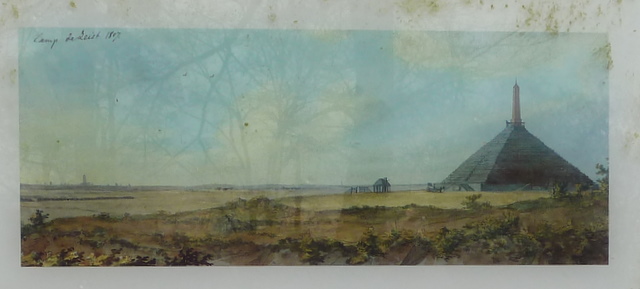
The Pyramid of Austerlitz
On 19 jan. 2011 I visited with my friend Joop van Keulen the Pyramide van Austerlitz near Utrecht, in the middle of the Netherlands. Here are some details!
(52.5'17.7" N; 5.20'24.6" E)
1. The monument of Marmont.
The Pyramide van Austerlitz has been erected on the 12th of october 1804 by the 30-years old French general Auguste F.L.V. de Marmont as a memorial of the camping of his 18.000 amy men on the moor of Zeist. Officialy he dedicated this monument to Napoleon who was crowned emperor that year.
Marmont choose for a simple memorial that he could quickly and cheap build and that would last for ages: a piramid of earth and turf with a wooden obelisk and a senic view. It was indeed a beautiful view over the moor and the Zuidezee (now called: IJsselmeer). From this lake an English invasian could be expected.
In 1806 king Louis Napoleon gave this monument the name of 'Pyramide van Austerlitz' in honour of the Battle of Austerlitz in Techia, won by his brother. Since the village nearby the army camp is also called Austerlitz.
When Marmont left in 1805 the piramide was later fallen into disrepair. In 1894 the major J.P.de Beaufort placed a new stone obelisk.
2. Inspiration.
Marmont's inspiration for this monument was the Piramid of Gizeh he had seen during the Campaign of Egypt with Napoleon in 1798. Even the steps were copied.
After the Egyptian Campaign all kinds of Egyptian motives became popular in Europe. This Egyptian mania was seen in gravestones in the form of piramids. But the greatest piramid of Europe you can see here!
3. Position.
First this piramid was called 'the hill of Marmont'. For this French general this memorial was the centre of Holland. It is 49,5 m above seelevel. By beuatiful weather you were able to see the Zuiderzee, Amsterdam, Breda, Zwolle and the towers of Utrecht and Amersfoort. Nowadays this is over, there are woods all around.
4. Construction and guardning.
On the 10th of september 1084 Marmont and his soldiers started to build. A leaden box containing a parchment with all the names of the soldiers was put in. This box was digged out in 1893.
After 27 days about 30.000 cubic meters of earth were moved for the 36m high piramid, who has 40 steps on a 2m high basement. Then the 13m high wooden obelisk was placed. A circle of 90m was digged around the piramid.
On the 12th of october was the festive opening and on the 21th of october there was a great dinner.
Only in march 1805 the four great memory stones dedicated to Napoleon and his great victories were attached on the piramid.
For guardning and repair Marmont appoitnted three married soldiers for whom he let build little houses round the piramid. He expected this place to become a village, called 'Marmontville', but this didn't happen.
The houses were demolished in 1836.
maandag 10 januari 2011
Napoleon in Rotterdam!
On sunday 9 jan. 2011 I was in the Walhala-theater in Rotterdam.
There was the presented in a monoloqueform Napoleon, the Hanged. (Napoleon, de Gehangene.)
It was the actor Coen van Vlijmen (he has the look of Napoleon too!), presenting an overview of the life of our hero on St.Helena. He has, like me, also been there himself in 2008.
It was nice done, about a hunderd spectators and during three days.
I took no pictures during the session, but I did before.
We had a nice afternoon!
zondag 7 november 2010
General Jean Baston de Lariboisière
In the summer of 2010 we visited the place Fougères (France, 48.21.08 N, 01.12.10 W).
This little town is the place of birth of Comte Général Jean Baston de Lariboisières. (1759-1812) He was a very old friend of Napoleon (already in 1793) and was artillery-general. His last job was to be the first inspector-general of the artillery. He has got a statue in Fougères.
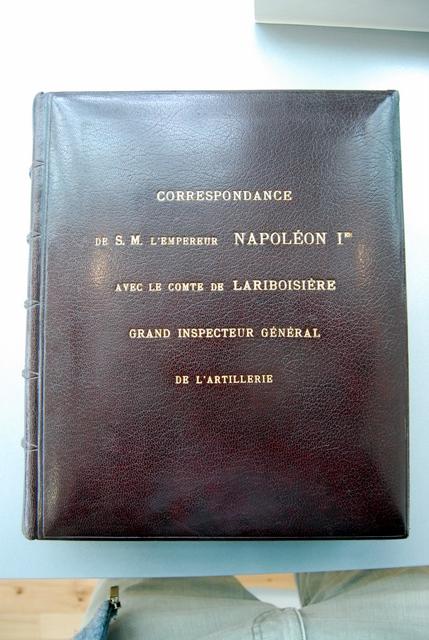
He maintaind also a correspondance with with his boss. Napoleon sand him 73 lettres. Now these are collected in a kind of book.
This little town is the place of birth of Comte Général Jean Baston de Lariboisières. (1759-1812) He was a very old friend of Napoleon (already in 1793) and was artillery-general. His last job was to be the first inspector-general of the artillery. He has got a statue in Fougères.
I entered about ten o'clock the public library in with this was stored. No sir, at the other site of this building, but not for 14.00u. I returned. No sir, we do'nt even know if we have that book. I looked in the computer. It was no. 27 of their cataloque! No sir, you must have a written permission and that takes minimal a week.
And that book is stored in the safe. But after a little explanation, my visitecard eso. the two women stayed away for half an houre and came back with the book!
I had to put on white handgloves and there it was: all that 73 letters from Napolen to General de Lariboisière.
Of course I was very impressed, the signature of Napoleon was realistic for my eys! Sneaky I touch it with my bare hand! It gave me an enorm positive feeling!
Was I allowed to take pictures? Of course sir, no flash. What are you going tot do with that pictures? I explained my website (http://www.roelkvos.nl/guide%20napoleon) and my weblog. I had to sign a list for every picture I took.
After an houre I had seen enough. Thankfully I sayd goodby. I have had a wonderful day!
Below you can see the results of this afternoon.
donderdag 4 november 2010
A new book about Napoleon
During one of the last days I was in France this summer I did my shopping in a brand new supermarket of E.Leclerc. Since a few years you meet in the front of such new buildings a lot of other shops, also a vast bookstore of E.Leclerc itself.
I saw this book about Napoleon and of course I bought it at once.
When it's opend you see directly that this book is artificially elderd.
More: there are copies of letters of Napoleon, battlemaps, eso.
The tekst is good, but not amazing.
The pictures are well known.
But: the layout and the size stroke me.
See for your self!
(Today (fryd 5th nov. 2010 I was in the American Bookstore in The Hague (Netherlands). There I saw this book in English!)
Abonneren op:
Posts (Atom)